


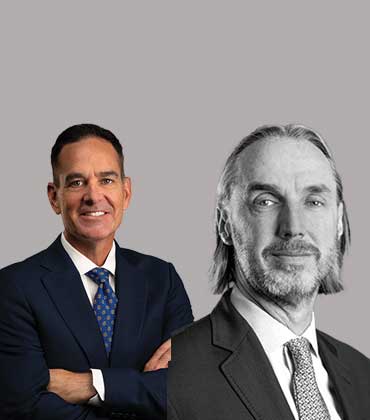
 Ron Redell, President and Jeffrey Sherman, Deputy Chief Investment Officer
The firm sees opportunities as well as risks in this regime change. The objective for the client, however, remains the same: “a smoother ride for investors,” as DoubleLine President Ron Redell puts it, “while outperforming over full market cycles.” Fulfilling that mission includes diversified distribution, he says, catering to client preferences in investment vehicles – from active ETFs to UCITS to CITs to SMAs and beyond – and robust client service. With respect to markets, Deputy Chief Investment Officer Jeffrey Sherman says DoubleLine in general focuses on an 18-to-24-month horizon. Spurning unidirectional market bets, the investment team seeks to construct bond portfolios to perform even in scenarios that depart from the firm’s base-case outlook.
Investment-Led, Not Distribution-Led
As a business culture, DoubleLine prides itself on an investment-led ethos rather than a distribution-led business model. New strategies, Messrs. Redell and Sherman say, are never conceived to capture short-term product fads or to clone commoditized strategies already on offer. The firm enacts strategies out of conviction in their soundness, distinctiveness in the marketplace and appeal to DoubleLine members themselves.
Through open and in-house channels, we seek to communicate in a concise, timely and actionable way to our investors.
DoubleLine’s Flexible Income strategy exemplifies the firm’s disdain for hot-product mimicry. “Flex” was launched in 2014. At the time, amid consensus expectations for economic growth and higher interest rates, asset managers were rolling out “unconstrained bond” strategies biased in favor of going long spreads and shorting rates. Mr. Sherman rebuffs that positional predisposition as “the antithesis of both active management and fixed income investing.” Unconstrained to an index, the DoubleLine strategy has flexibility. However, although its guidelines allow wide latitude in the management of duration (interest-rate sensitivity), the floor is set at zero years, excluding the option of shorting interest rates. And while ready as circumstances allow to take credit risk, the portfolio managers are selective where they take it and make no apologies when playing defense. “Here we are more than 10 years later,” Mr. Sherman says, “and I think the results of our strategy and other unconstrained offerings speak for themselves.”
Best known for active fixed income management, DoubleLine in collaboration with Barclays has brought to market equity funds based on systematic (aka smart beta) strategies. As an example of the firm’s insistence on distinctive-over-generic offerings, Mr. Sherman cites the DoubleLine Fortune 500 Equal Weight equity strategy. Other equal-weight stock strategies target companies by market capitalization. For its equal-weight stock strategy, DoubleLine avoids market capitalization not only as a weighting mechanism but also as a holding selection criterion: The DoubleLine Fortune 500 Equal Weight strategy populates its portfolio with large revenue-generating companies making the annual Fortune 500® list.
Investment Operations: Tight Ship, Close-Collaborating Crew
Portfolio managers, traders and analysts work side by side on a single trading floor in Los Angeles. This enables immediate communication as market conditions unfold in real time. During the deliberative processes of security research and selection, investment team members, from portfolio managers to analysts to traders, are encouraged to contribute ideas and challenge assumptions.
 DoubleLine offers strategies targeting specific fixed income sectors such as mortgage-backed securities, emerging markets debt and floating-rate corporate assets and multi-sector strategies (including core), which integrate dynamic allocation among sectors with bottom-up security selection. Sector allocation embraces understanding of the macroeconomic environment as well as relative values and fundamentals among the various sectors of the fixed income universe.
The Fixed Income Asset Allocation Committee, led by CEO and Chief Investment Officer Jeffrey Gundlach and co-chaired by Mr. Sherman, determines sector weightings of the multi-sector portfolios and aggregate portfolio characteristics such as duration and credit exposure. Bottom-up security selection is managed by teams specialized in their respective sectors: Agency and non-Agency residential mortgage-backed securities, Agency and non-Agency commercial mortgage-backed securities, asset-backed securities, corporate credit (investment grade and high yield bonds and bank loans), collateralized loan obligations and sovereign debt (including U.S. Treasuries).
Primacy of Risk Management
In contrast to the possibility of extreme gains in equities, Mr. Sherman – like Mr. Gundlach a mathematician by academic training – observes “fixed income returns tend to be earned gradually while losses can strike with the violence of a step function.” At the aggregate portfolio level, this means careful planning around the drivers of risk and return, including duration, credit quality, valuation and yield.
Private Ownership: Independence, Interest Alignment, Generational Renewal
In an asset management industry dominated by publicly traded firms or subsidiaries of parent companies, DoubleLine remains privately held and majority employee-owned. According to Mr. Redell, private ownership incentivizes stakeholders to work toward a shared goal of delivering strong outcomes for investors, key to DoubleLine’s success. Absence of external majority ownership eliminates remote managers influencing or even dictating business strategy, including product development. Employee ownership, he says, also supports continuity. From 45 professionals at the time of its founding, DoubleLine has grown to 263 employees, including 92 investment professionals. The partnership track rejuvenates the talent pool as promising younger members grow into key contributors.
Channel Diversification, Matched to the Client
By mid-2011, DoubleLine had established itself as the fastest-growing mutual fund startup of the previous 25 years. With subsequent growth in assets and strategies, DoubleLine also diversified its distribution channels to meet client preferences. The firm’s proprietary ETF platform illustrates that evolution. With the launch of the DoubleLine ETF Trust in 2022, Mr. Redell announced, “As steward of our clients’ investment capital, DoubleLine has diversified its distribution channels to match the preferences of investors and their intermediaries. We are devoted to the clients who count on our existing investment vehicles, including mutual funds, other pooled-capital vehicles and separate accounts, while remaining open to new vehicles that win public endorsement.”
In four years, the platform has grown to 10 exchange-traded funds and $2.9 billion in assets. “Of course, we’re proud of the platform’s growth,” says Scott Thomson, Director, ETF Capital Markets, at DoubleLine. “Just as important is the diversity of clients utilizing our ETFs today. They span registered investment advisers, institutions, broker-dealers, strategists and wirehouses. In addition to new product development, we intend to build on this foundation by scaling existing strategies and expanding availability across wealth-management platforms and models, as well as building new partnerships using our in-house ETF models.”
-
At the cornerstone of how we think about markets is that we use macro to be our guide from the top-down standpoint, but everything that we build in a portfolio is done at the security level.
Among future initiatives, DoubleLine is exploring ways to build on the suite of strategies offered through its collective investment trust (CIT) structure. The stable-value and retirement arenas appear well suited to this effort. Stephen Dopp, who joined the firm earlier this year as Relationship Manager for U.S. Retirement, leads the effort to bring DoubleLine solutions to market aimed at helping allocators, plan sponsors and participants to de-risk retirees’ savings in a systematic and repeatable way.
“The proliferation of customization in retirement plans lends itself to what DoubleLine does best,” says Mr. Dopp. “As participants approach their higher-earning years, we are working to deliver solutions that bridge the product gap between capital accumulation and preservation.”
Client Service and Communication
Beyond standard client reporting, DoubleLine communicates its perspectives through webcasts, social media, published research and speaker forums. Its portfolio managers are sought-after commentators in leading financial media. They appear on such video news platforms as Bloomberg Television, CNBC, CNN Business and Fox Business, and are quoted in news services and publications such as Barron’s, Bloomberg News, Citywire, Financial Advisor, the Financial Times, Kiplinger’s Personal Finance and The New York Times and Reuters. Mr. Redell believes that effective communication is an important part of serving clients. “Through open and in-house channels,” he says, “we seek to communicate in a concise, timely and actionable way to our investors.”
